Research
Superconductivity, light and matter
Simulation of two-band superconductors, the main line of work, and two projects started in 2026: first-principles nonlinear optics of Weyl semimetals and an open computational lensmeter.
Two-band superconductors: simulation and validation
A three-dimensional, two-band time-dependent Ginzburg–Landau solver for mesoscopic superconductors under applied field and transport current, designed, written and validated independently. Two order parameters coupled by a Josephson term and a self-consistent vector potential on a staggered mesh with gauge-invariant link variables; the current is injected through its own Ampère field, and the voltage is read from the Josephson relation on the gauge-invariant phase. Released as open source.
v13.3 Octave reference implementation (hash df37e31c), the origin of the stored reference states. v14.1 Julia port, bit for bit against v13.3, with an optional scalar potential by Coulomb projection. 1.0 juliaTDGL, public release (MIT, October 2026): optional terms for interband drag, heating, Joule dissipation and bath temperature, all off by default; a Strict mode that reproduces the reference bit for bit and a Fast mode; a terminal menu for runs and a browser editor for 3D sample shapes. 1.1 An implicit treatment of the curl-curl term, which removes the Maxwell limit on the time step of strongly screened samples, and sub-stepping of the stiff band; validated against the explicit scheme (onset brackets identical, flowing voltages within 0.2 %), about 3 times faster per unit time at κ = 2 and about 100 times at κ = 25. The explicit scheme remains the default, so published numbers reproduce. Validation
- Bit-for-bit agreement with the stored reference states (maximum difference 0 on 32 arrays).
- Lowest Landau level within 1.6 % at the production mesh; surface-nucleation ratio H_c3/H_c2 within 0.05 % of 1.6946.
- About 56 000 test assertions, including a slow reference loop for the kernel, gauge invariance of the scalar-potential step and every optional term.
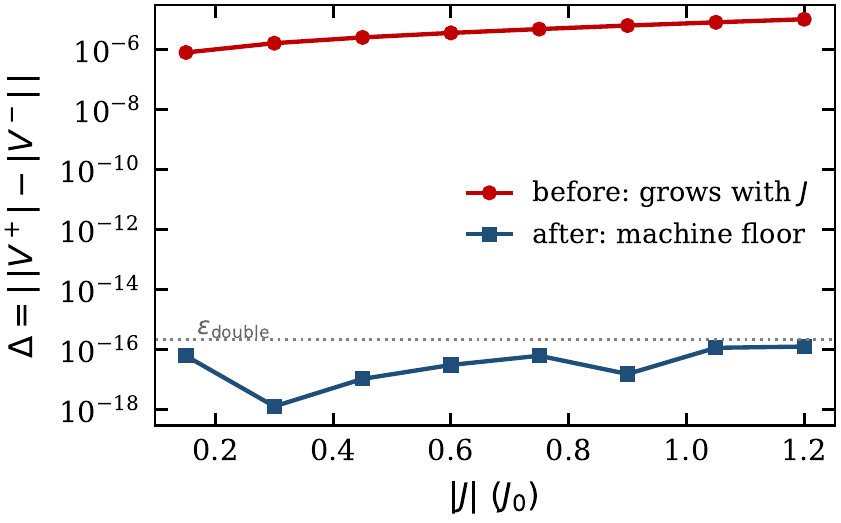
- Symmetry control: a sample symmetric under the mirror along the vortex motion gives zero diode efficiency — exactly in exact arithmetic, to a few parts in 10¹¹ in practice.
Methods paper
Read the preprint (Zenodo) Code: juliaTDGL
Protocol
Eighteen ways a converged simulation can report the wrong quantity
- Each failure mode produces a converged, plausible number that does not measure what it is reported as, and each has a test.
- The central one (M1): a phase imposed uniformly on the contact links cancels in the discrete curl, so the solver integrates the zero-current problem. Self-field injection, odd in the current, and a Josephson voltmeter replace it.
- Others concern averaging windows that set a threshold, the memory of a current ladder, convergence floors counted in iterations, coefficients whose names mislead (M16, M17), and heat generated where injected normal current converts into supercurrent (M18).
Two-band condensate
What the functional allows in equilibrium
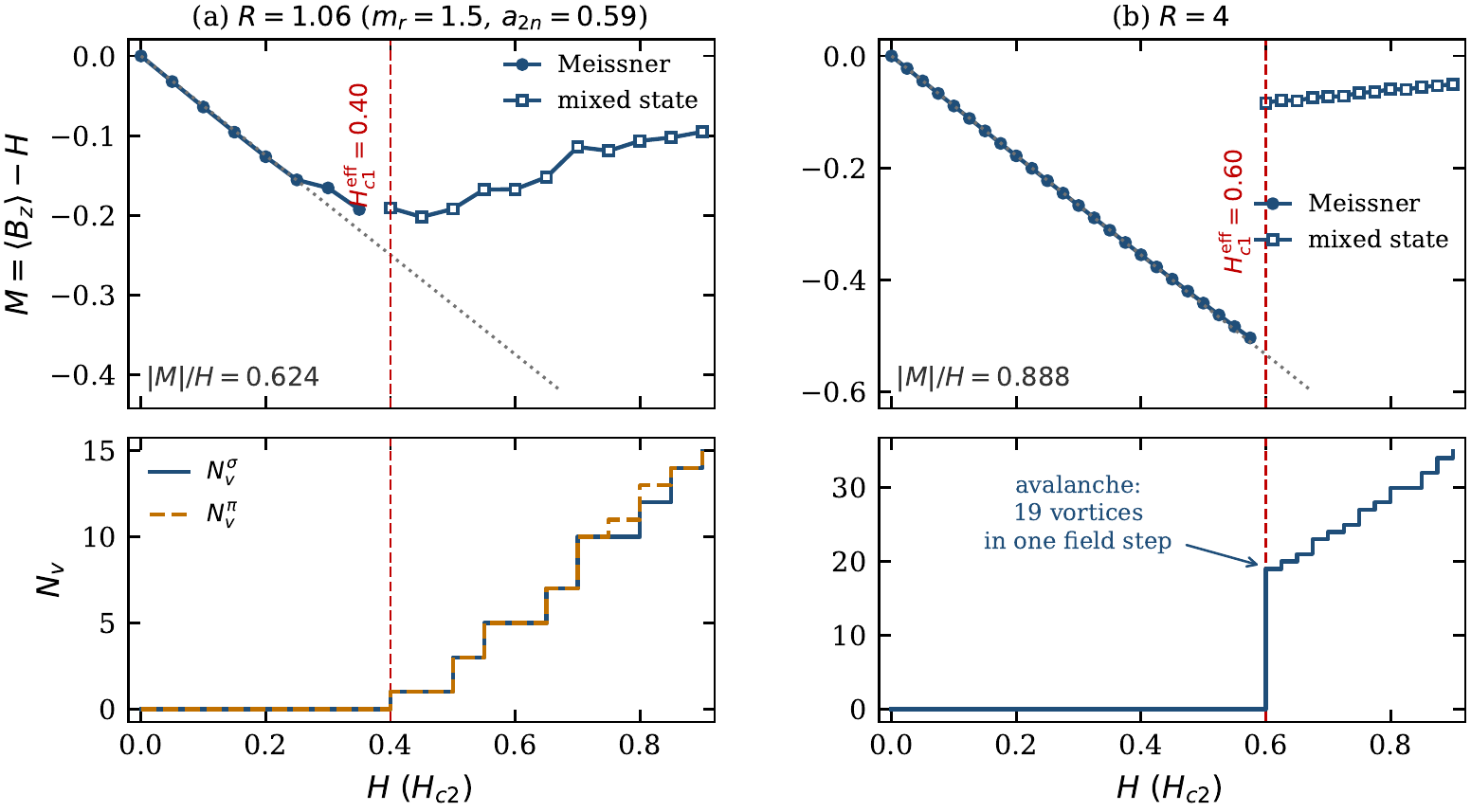
- Screening measures the total stiffness of the two condensates.
- The functional caps the π-band upper critical field by the stiffness partition (H_c2^π/H_c2^σ ≤ ρ_σ/ρ_π), so separated coherence lengths and a bulk π band that survives vortex entry exclude each other in these samples.
Superconducting diode
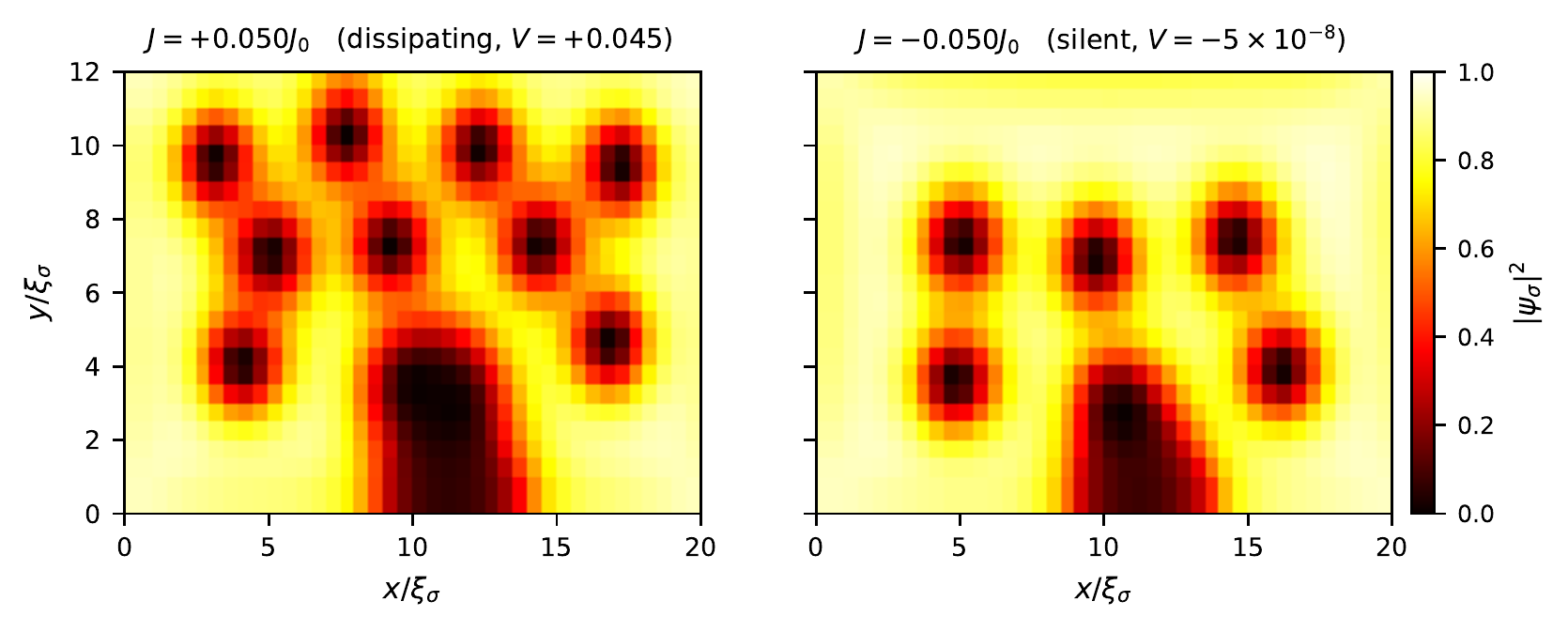
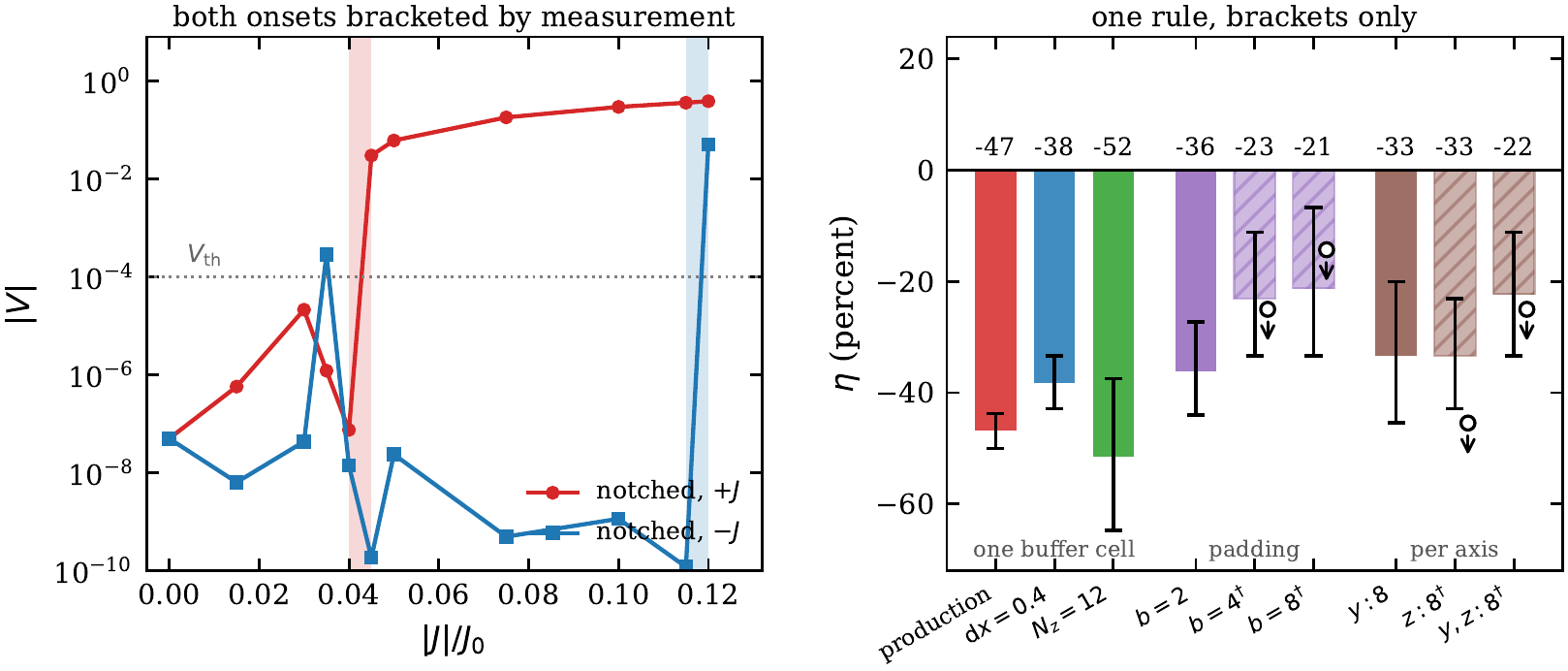
A notched box rectifies; the sign is robust, the magnitude is bracketed
- The sign survives changes of mesh, thickness and padding, and is fixed by symmetry: complex conjugation composed with the mirror maps +J onto −J.
- The efficiency falls from −47 % with one cell of padding (a normal metal in this formulation) to −21 % [−33, −7] with eight cells; no converged value is quoted.
Figures from the paper
Second paper (manuscript under review)
Rectification in a notched two-band box at low field: two screening regimes and the terms that leave it unchanged
At a field where the box holds no vortex at zero current, the voltage is carried by single σ-band vortices (or antivortices) nucleating at the tip of the notch, one per period; rectification is the asymmetry of the waiting time at the tip. Two screening regimes, and the effect of scalar potential, charge relaxation and heating on the onsets.
Currently
The same geometric diode at MgB₂-like parameters — strong screening and well-separated coherence lengths of the two bands — and what Joule heating and interband drag do to it. The longer-term direction is multiband, non-equilibrium TDGL for three-dimensional superconducting nanostructures, a regime that two-dimensional codes cannot reach.
Started September 2026
Nonlinear optics of Weyl semimetals from first principles
How do shift and injection photocurrents and second-harmonic generation in magnetic Weyl semimetals depend on the treatment of the f electrons and on the direction of the magnetization, and where does perturbation theory stop being sufficient? Guiding rule: reproduce the measured linear optical conductivity before trusting any nonlinear prediction.
Completed so far
- Analytic Weyl lattice model in real time (Julia): reproduces the quantized circular photogalvanic response of de Juan et al. (2017) without perturbative formulas (Tr β/β₀ = 1.014 on a 96³ grid), and shows the breakdown and Rabi-like rebound of quantization at strong fields.
- Octopus real-time TDDFT validated on silicon, including a symmetry null test: a zero-area pulse leaves no DC current, as inversion requires.
- Quantum ESPRESSO → Wannier90 chain for GaAs running, with band energies reproduced at high-symmetry points — the starting point for the shift-current benchmark.
- Interactions in the model: a local mean field barely changes the quantized response, while a non-local exchange term breaks it already at first order.
Next: Shift current of GaAs against the literature, then a measured Weyl semimetal.
Design stage
An open computational lensmeter
A phone camera's RAW sensor and a laptop screen measure spectacle lenses by transmission deflectometry: the camera looks at a pattern on the screen through the lens, and the pattern's distortion gives the lens prescription — sphere, cylinder and axis — with an uncertainty, aiming at the ISO tolerance of ±0.12 D, together with the full power map. The physics and mathematics sit in two pieces: an elliptic inverse problem on a masked domain, solved by conjugate gradients preconditioned with a fast cosine transform, and a thick-lens model fitted at several lens–screen distances.
Completed so far
- Simulation: a thin-lens estimate at 5 cm is biased by 0.13–0.34 D on real spectacle lenses; a two-surface model fitted at three distances brings the bias below 0.005 D.
- Core inverse solver checked numerically on a curved domain (error 4 × 10⁻¹¹ in 24 preconditioned iterations).
Next: Characterize the sensor and the screen, validate on a synthetic lens, then measure several spectacle lenses against an optician's lensmeter.
The animated panels are computed in the browser from analytic models (and from the measured diffraction data, in the case of the crystal); they illustrate the physics and are not output from the research codes.